

Medically reviewed by Shaun Larsen, OD – Doctor of Optometry, Southern College of Optometry.
Last clinically reviewed: July 2026 | Next scheduled review: July 2027
In brief: high cholesterol itself causes no eye symptoms – no pain, no blurring, no redness. What it produces are visible signs that an examiner can see: lipid deposits in the cornea and eyelid skin, and, most importantly, cholesterol emboli lodged in the retinal arteries. That last finding matters most, because it usually means plaque is breaking off from a carotid artery, and it carries a meaningful stroke risk. This page covers what each sign looks like, what it actually predicts, and which ones require prompt action.
Symptoms versus signs – the distinction that matters here
High cholesterol is asymptomatic. It causes no sensation anywhere in the body, including the eyes, which is why it is detected by a blood test rather than by how you feel. Nobody experiences high cholesterol.
What cholesterol does produce is signs – physical findings another person can observe. Some are visible in a mirror; most require a slit lamp or a dilated retinal examination. This distinction is why an eye examination is genuinely useful in cardiovascular risk assessment: the retina is the only place in the body where arteries can be viewed directly and non-invasively.
It also means the reverse inference does not hold. Absence of these signs does not indicate normal cholesterol – most people with raised cholesterol have entirely normal-looking eyes. Only a lipid panel can tell you your cholesterol level.
The urgent one: cholesterol emboli in the retina (Hollenhorst plaque)
This is the finding the original version of this page omitted, and it is the one that carries real consequences.
A Hollenhorst plaque is a small, bright, yellow-orange refractile fragment of cholesterol lodged at a branching point in a retinal arteriole. It has broken off from an atherosclerotic plaque upstream – most often in the internal carotid artery on the same side, sometimes from the aortic arch or the heart. The ophthalmic artery is the first branch of the internal carotid, which is why debris from the carotid so readily reaches the eye.
Why it matters far beyond the eye. The same embolic source that sent a fragment to the retina can send one to the brain. A retinal embolus is, functionally, a stroke that happened to land in the eye instead. Studies of symptomatic emboli have found a substantial proportion of patients to have significant carotid stenosis, and the presence of retinal emboli is associated with elevated risk of subsequent cerebrovascular events. Consensus practice is that a Hollenhorst plaque – whether or not it caused symptoms – warrants prompt evaluation for an embolic source, typically carotid duplex ultrasonography, alongside cardiovascular risk assessment.
What patients may notice – or not. Many Hollenhorst plaques are entirely asymptomatic and are found incidentally on a routine dilated examination. Where they cause symptoms, the classic presentation is amaurosis fugax: sudden, painless, transient loss of vision in one eye, often described as a curtain or shade descending and then lifting, lasting seconds to minutes with complete recovery.
Amaurosis fugax is a medical emergency and must not be dismissed because vision came back. It is the ocular equivalent of a transient ischaemic attack and carries the same implication – that a larger event may follow. Anyone experiencing it should be assessed urgently, the same day.
When the embolus does not pass, the result is a retinal artery occlusion – sudden, painless, permanent loss of vision in one eye, either across the whole field (central retinal artery occlusion) or in a wedge-shaped sector (branch occlusion). This is a stroke of the eye and is treated as an emergency: current guidance is to attend an emergency department for immediate stroke workup rather than an eye clinic, because the priority is identifying and treating the embolic source before a cerebral event occurs.
One critical differential in anyone over 50: sudden painless vision loss with headache, scalp tenderness, jaw pain on chewing, or unexplained malaise may indicate giant cell arteritis, which requires immediate high-dose corticosteroid treatment to protect the fellow eye and is both sight- and life-threatening. Do not wait.
Corneal Arcus
Corneal arcus is a grayish-white arc visible above and below your outer part of cornea (the clear domelike covering in front of your eye), sometimes known as an “arcus senilis” or “arcus juvenilis”, caused by fat deposits deep within cornea known as lipids; typically found among older adults but can occur among younger individuals as a result of severe familial hyperlipidemia (inherited high cholesterol and triglyceride levels).
What it looks like in detail. Lipid deposits accumulate in the corneal periphery, beginning at the inferior and superior poles and eventually extending to form a complete ring. A characteristic feature is the clear zone between the outer edge of the arc and the limbus – the deposit does not reach the very edge of the cornea. Arcus does not affect vision, is not painful, does not progress across the visual axis, and requires no treatment.
What it actually predicts – and this is where age is everything.
- Under about 45–50: arcus is genuinely significant. In this age group it is associated with dyslipidaemia and warrants a lipid panel. In the Lipid Research Clinics follow-up study, arcus was associated with substantially raised coronary heart disease and cardiovascular mortality specifically in hyperlipidaemic men aged 30–49. Unilateral or markedly asymmetric arcus in a younger person is a different signal again – it can indicate reduced blood flow on the unaffected side from carotid disease, and warrants vascular assessment.
- Over about 60: arcus becomes very common as an ageing change and its independent predictive value falls away. The large Copenhagen City Heart Study found arcus not significantly associated with cardiovascular outcomes or mortality after adjustment for age, sex and standard risk factors, and a recent systematic review concluded it offers limited independent prognostic value in general older populations. In an older adult, arcus is best understood as reflecting cumulative lifetime lipid exposure rather than as a current risk marker.
And the reverse inference fails badly: arcus has low sensitivity. Its absence does not exclude high cholesterol or cardiovascular disease, and no one should take a clear cornea as reassurance about their lipids.
High cholesterol does not directly cause blurred vision, double vision, haloes or peripheral vision loss. Those symptoms have their own causes and should be investigated on their own terms – haloes with eye pain and nausea may indicate acute angle-closure glaucoma, an emergency; progressive peripheral loss suggests glaucoma; sudden double vision requires prompt assessment. Attributing them to cholesterol risks a serious delay.
The vision-threatening consequences of cholesterol are vascular events – retinal artery occlusion, retinal vein occlusion, and ischaemic optic neuropathy – and these present suddenly rather than as a gradual change.
Your eye doctor will conduct tests to assess these changes and recommend treatment as necessary. Your symptoms could be reduced by adopting healthier eating habits and avoiding foods rich in fats and cholesterol. Speak to your healthcare provider about taking prescription medication or increasing physical activity depending on what’s causing them. Your physician could refer you to a specialist for further evaluation if other conditions that could be caused by high cholesterol are also present, such as diabetes or cardiovascular disease.
Xanthelasma Palpebrarum
Xanthelasma palpebrarum is a deposit of lipid in the eyelid skin, appearing as yellowish plaques on either upper or lower eyelids, most often near the inner canthus area. An imbalance in cholesterol and triglyceride levels often triggers them; other potential associations include thyroid dysfunction, diabetes and primary biliary cholangitis.
Xanthelasma palpebrarum is the most prevalent form of cutaneous xanthoma and can occur on various areas of the body, most frequently on eyelids and top of eyelids. While not medically serious, cosmetic issues may arise as lesions appear as yellow-white plaques on top of eyelids , typically soft, flat or slightly raised, with well-defined borders, often symmetrical between the two eyelids and tending to enlarge slowly over time. They do not cause pain.
What xanthelasma predicts – and this is the more interesting finding the page currently misses. The Copenhagen City Heart Study followed a large general-population cohort and found xanthelasma associated with increased risk of myocardial infarction, ischaemic heart disease and mortality independently of lipid levels and after adjustment for age, sex, cholesterol, triglycerides, BMI, hypertension, diabetes and other standard risk factors. The association held in subgroups down to ages 40–49. Notably, in the same study corneal arcus showed no such independent association – so of the two classic lipid signs, xanthelasma is the one carrying independent prognostic weight.
The practical consequence: xanthelasma should prompt a lipid panel and a formal cardiovascular risk assessment even if cholesterol turns out to be normal, since roughly half of people with xanthelasma are normolipidaemic yet the risk signal persists. It is worth adding that not all evidence agrees – a large retrospective screening-cohort analysis published in 2024 found no association between xanthelasma and dyslipidaemia or cardiovascular disease, so the picture is not settled. The reasonable position is that xanthelasma warrants assessment rather than alarm.
Xanthelasma is often associated with elevated cholesterol and decreased HDL-C levels, but may also be caused by other factors like primary biliary cholangitis, uncontrolled diabetes or inflammatory skin diseases. Women are more prone to it than men.
Treatment. Two separate objectives, and conflating them is the main source of patient disappointment. Managing the underlying lipid abnormality addresses cardiovascular risk but rarely clears existing plaques. Removing the lesion is a cosmetic procedure: options include surgical excision, CO₂ or erbium:YAG laser ablation, chemical cauterisation with trichloroacetic acid, electrodesiccation and cryotherapy. Recurrence is common after any of these, particularly where the lipid abnormality remains uncontrolled, and patients should be told so beforehand. Because xanthelasma is harmless in itself, removal is elective.
Lipaemia retinalis
A rare but visually striking finding worth including, because it signals a specific and urgent problem. When serum triglycerides reach extreme levels – typically above roughly 2,000 mg/dL – the retinal blood vessels take on a creamy, salmon-pink or milky-white appearance, because the blood itself becomes lipaemic. In severe cases the entire fundus looks pale.
It usually causes no visual symptoms, and it resolves completely once triglycerides are brought down. Its importance is as a marker: severe hypertriglyceridaemia at these levels carries a substantial risk of acute pancreatitis, which is a serious and sometimes life-threatening condition. An incidental finding of lipaemia retinalis therefore warrants urgent lipid measurement and medical referral, not simply a note in the record.
How cholesterol modifies other eye disease
Beyond the direct deposits above, lipid status influences several conditions:
- Retinal vein occlusion. Hyperlipidaemia is an established risk factor, alongside hypertension and diabetes. RVO presents as sudden painless loss of vision in one eye and is itself a marker of systemic vascular disease – the eye finding should trigger a cardiovascular workup.
- Non-arteritic anterior ischaemic optic neuropathy (NAION). Associated with cardiovascular risk factors including dyslipidaemia, and with a small crowded optic disc. Presents as sudden painless vision loss, typically noticed on waking.
- Diabetic retinopathy. Lipid control does not cause or prevent retinopathy, but elevated lipids are associated with hard exudates and with the risk of macular oedema. Lipid management is part of comprehensive diabetes care alongside glycaemic and blood pressure control.
- Age-related macular degeneration. Lipid metabolism is genuinely implicated in AMD pathogenesis – drusen contain lipid, and Bruch’s membrane accumulates lipid with age. However the epidemiological relationship between serum cholesterol and AMD risk is inconsistent, and statin therapy has not been shown to prevent or treat AMD. This should not be overstated.
- Corneal deposits from lipid-lowering medication are not a recognised concern; statins do not deposit in the cornea. Corneal verticillata – a whorl-like deposit – is associated with amiodarone, hydroxychloroquine and Fabry disease, not with lipid therapy.
Diabetic Retinopathy
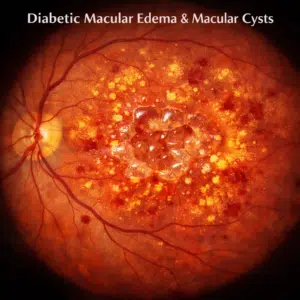
Over time, diabetes’s high blood sugar levels damage the delicate blood vessels that provide nourishment to the retina (light-sensitive tissue lining the back of the eye). Damaged cells release fluid or hemorrhage, swelling up the retina with fats, proteins, and other substances which float around and interfere with vision. Those lipid and protein deposits left behind after fluid resorbs are hard exudates, and this is the specific point at which cholesterol becomes relevant to diabetic eye disease – raised serum lipids are associated with more extensive exudate formation and with macular oedema risk. In diabetes, a sudden shower of floaters usually indicates vitreous haemorrhage rather than exudate, and warrants prompt assessment. untreated diabetic retinopathy could result in permanent vision loss or blindness.
Diabetic retinopathy comes in two forms, non-proliferative diabetic retinopathy (NPDR) and proliferative diabetic retinopathy (PDR). At its earliest stage, blood vessels that supply the retina may leak clear fluid or even hemorrhage; fluid may collect at the center of the retina leading to macular edema. As the disease advances, its weakened vessels begin generating new ones to try transport more blood to it; these new vessels are fragile and grow in the wrong place, bleeding into the vitreous or contracting to pull the retina forward, which causes tractional detachment.
Symptoms of NPDR include blurry vision, dark areas in the line of sight or distortion or loss of central vision. It is worth stating clearly that early and even moderately advanced diabetic retinopathy is usually completely asymptomatic – waiting for symptoms means presenting at the stage where damage is irreversible, which is why the screening schedule matters more than how the eyes feel. Patients can minimize further progression by keeping blood sugar, blood pressure and cholesterol within target ranges; regular dilated eye exams and retinal photography sessions will also help detect early warning signs to ensure vision loss is prevented and vision preservation preserved.
Anyone with diabetes is at risk of diabetic retinopathy; those diagnosed recently or those living with long-standing diabetes have an increased risk. Duration is the dominant factor – risk rises steadily with years since diagnosis. Smokers, those with high blood pressure or cholesterol levels and gestational diabetes mothers all increase this risk significantly. Diabetic retinopathy can be treated using laser treatment, medication injections or surgery depending on its severity; treatment aims to stop further vision loss while simultaneously improving quality. Current practice: intravitreal anti-VEGF injection is first-line for centre-involving macular oedema, and panretinal photocoagulation remains the definitive treatment for proliferative disease.
Glaucoma
Glaucoma is an eye condition which gradually damages the optic nerve and leads to vision loss. Elevated intraocular pressure is the principal modifiable risk factor rather than the definition – a substantial proportion of glaucoma occurs at pressures that never exceed the normal range. IOP puts pressure on the optic nerve, potentially damaging it irreparably if left untreated and may result in blindness over time.
Glaucoma can take various forms, but they all result in gradual peripheral vision loss. Open-angle glaucoma is the most prevalent type, caused when drainage areas in the eye become blocked up and not enough fluid drains out of them. Because symptoms may not show until vision loss has occurred, regular visits with your eye care professional for thorough eye exams is advised.
Narrow-angle glaucoma typically develops suddenly. It occurs when an eye’s iris becomes close to the drainage angle, blocking fluid drainage out of it and leading to symptoms such as blurred vision, rainbow halos around lights, headaches, severe eye pain and nausea or vomiting – this condition should be treated by medical professionals or in emergency rooms immediately. This is acute angle closure, and it is a same-day emergency – permanent damage can occur within hours.
Glaucoma can be effectively treated using prescription eyedrops, medications to lower eye pressure and laser therapies in certain patients. Furthermore, regular dilated eye exams should be scheduled in order to detect early symptoms and begin treatment immediately before it worsens further.
People at high risk for glaucoma include those who have diabetes, high blood pressure, or are African-American. If these risk factors apply to you, it is especially crucial that you schedule regular eye examinations at your eye care provider.
No diet, supplement or lifestyle measure has been shown in a randomised trial to prevent glaucoma – the only intervention with proven benefit is lowering intraocular pressure. General cardiovascular health is worth maintaining on its own merits. On screening age: routine glaucoma screening from 18 is not recommended by any major guideline. The American Academy of Ophthalmology recommends a baseline comprehensive eye examination at age 40, with earlier and more frequent screening for those with a family history, African or Hispanic ancestry, diabetes, or high myopia.
What to do if you have any of these signs
- Get a lipid panel – total cholesterol, LDL, HDL and triglycerides, through your primary care physician. It is the only way to establish your actual levels, and eye signs cannot substitute for it.
- Ask for a cardiovascular risk assessment, not just a cholesterol number. Risk calculators incorporate age, blood pressure, smoking, diabetes and family history alongside lipids.
- If you have a Hollenhorst plaque or have experienced amaurosis fugax, treat it as urgent. This means carotid imaging and stroke risk assessment, not a routine follow-up appointment.
- If arcus appears before about 45, or is markedly asymmetric, mention it specifically – it may indicate familial hypercholesterolaemia, which is substantially underdiagnosed and highly treatable, or in the asymmetric case carotid disease.
- Keep dilated eye examinations up to date. The retinal vascular findings that matter are invisible without dilation, and most are asymptomatic when first detectable.
Seek same-day care for: sudden painless loss of vision in one eye, whether or not it recovers; a curtain or shadow crossing your vision; sudden vision loss with headache, scalp tenderness or jaw pain in anyone over 50.
Frequently asked questions
Can an eye test detect high cholesterol?
An eye examination can reveal signs associated with high cholesterol – corneal arcus, xanthelasma, retinal emboli, lipaemia retinalis – and those findings can prompt investigation. But it cannot measure your cholesterol, and most people with raised cholesterol have normal-looking eyes. Only a blood test gives you a number.
Does high cholesterol cause blurry vision?
Not directly. Cholesterol threatens vision through sudden vascular events – retinal artery or vein occlusion, ischaemic optic neuropathy – which cause abrupt loss rather than gradual blurring. Persistent blurring has other causes and should be investigated on its own terms.
Is a white ring around the iris always high cholesterol?
No. In adults over about 60 corneal arcus is very common and largely an ageing change with limited independent predictive value. Under about 45–50 it is more meaningful and warrants a lipid panel. It never affects vision and needs no treatment at any age.
Will lowering my cholesterol make xanthelasma or arcus go away?
Usually not. Corneal arcus is permanent. Xanthelasma occasionally improves with aggressive lipid lowering but generally persists and requires a procedure for cosmetic removal – with recurrence common, particularly if lipids remain uncontrolled. Treating the lipids is worth doing for your cardiovascular risk, not for the appearance.
What is a Hollenhorst plaque?
A cholesterol fragment that has broken off an artery upstream – usually the carotid – and lodged in a retinal arteriole, where it appears as a bright refractile yellow spot. It is often symptomless and found incidentally, but it indicates active embolic disease and warrants prompt carotid evaluation and cardiovascular risk assessment.
References
1. Christoffersen M, Frikke-Schmidt R, Schnohr P, et al. Xanthelasmata, arcus corneae, and ischaemic vascular disease and death in general population: prospective cohort study. BMJ. 2011;343:d5497.
2. Chambless LE, Fuchs FD, Linn S, et al. The association of corneal arcus with coronary heart disease and cardiovascular disease mortality in the Lipid Research Clinics Mortality Follow-up Study. Am J Public Health. 1990;80(10):1200–1204.
3. The Relation of Corneal Arcus With Cardiovascular Diseases: A Systematic Review. Cureus. 2025.
4. Association between xanthelasma palpebrarum with cardiovascular risk and dyslipidemia: a case-control study. Ophthalmology. 2024.
5. Hollenhorst RW. Significance of bright plaques in the retinal arterioles. JAMA. 1961;178:23–29.
6. Klein R, Klein BEK, Jensen SC, et al. Retinal emboli and cardiovascular disease: the Beaver Dam Eye Study. Arch Ophthalmol. 1999;117(8):1063–1068.
7. Society for Vascular Surgery. Guideline on the management of extracranial carotid disease – recommendations on carotid duplex ultrasonography in retinal embolic disease.
8. American Academy of Ophthalmology. Central Retinal Artery Occlusion – clinical guidance on emergency stroke evaluation. aao.org.
9. Rajagopal R, Bashir S, Aleem MA. Lipaemia retinalis. N Engl J Med. 2017;376:e6.
10. Nordestgaard BG, Chapman MJ, Humphries SE, et al. Familial hypercholesterolaemia is underdiagnosed and undertreated in the general population: guidance for clinicians. Eur Heart J. 2013;34(45):3478–3490.
11. American Academy of Ophthalmology. Comprehensive Adult Medical Eye Evaluation Preferred Practice Pattern. aao.org.






 Shop Best Low-Vision Aids with FREE Doctor Consultation.