
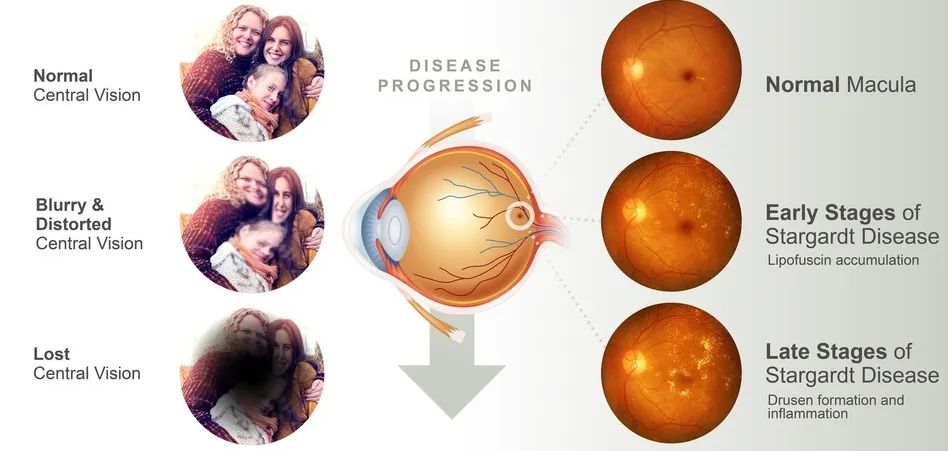

Stargardt disease is an inherited form of macular degeneration that affects the macula, or central portion, of your retina. Although Stargardt disease can often go misdiagnosed, early diagnosis allows you to prepare for potential changes to your central vision and can give an advantage to treatment strategies.
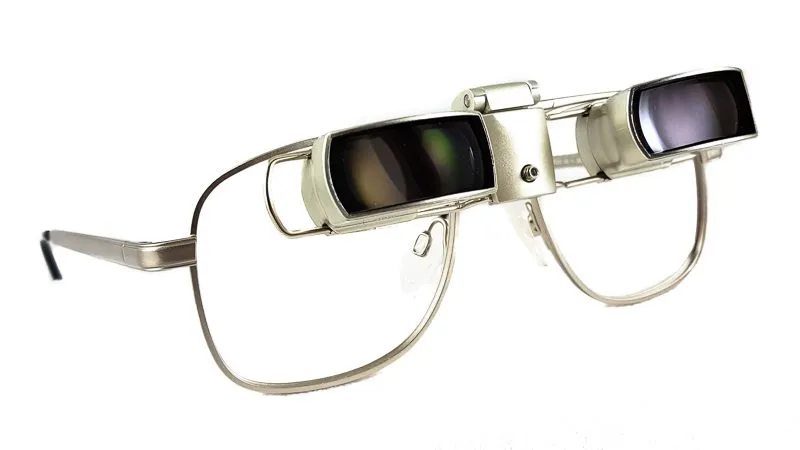
Most patients can utilize visual aids like electronic magnifiers or screen magnification software to manage their symptoms of Stargardt disease, while new treatments are currently being developed.
Symptoms
Stargardt disease is an inherited disorder that damages the macula (a small area at the center of retina) and leads to central vision deterioration, hindering facial recognition, driving and seeing straight lines (such as on road signs or clock faces). The disease usually appears during childhood or adolescence and worsens gradually over time.
Symptoms include blurry or distorted vision and a blind spot at the center of your field of view, making reading or driving difficult in dimly lit environments, while later stages usually result in loss of color vision.
Stargardt disease is caused by a mutation of the ABCA4 gene. This gene provides instructions for producing a protein that helps flush waste products out of your eyes, including fatty materials that build up in the macula (part of retina at back of eye responsible for central vision). When this gene malfunctions properly, however, waste material accumulates into yellowish clumps that kill macula cells and diminish central vision significantly.
Genetic tests can determine if you carry a mutation of the ABCA4 gene that puts you at risk of Stargardt disease and indicate its severity. They also help your physician identify patients that should be closely monitored by them.
Other tests may also help confirm and monitor progression of disease, such as fundus photography tests, optical coherence tomography (OCT), electroretinography (ERG), and blood testing to detect gene mutations that can contribute to this condition.
Treatment options for Stargardt disease are limited and there is no known cure, yet many patients still report improvements in quality of life following treatment. This may be attributed to similar regimens used for dry macular degeneration that have proven successful at managing Stargardt symptoms; such as low-dose cholinergic medications like echothiophate iodide or pilocarpine being most often employed as therapies against Stargardt disease.
Diagnosis
Stargardt disease is an inherited eye condition that attacks the macula, the central part of the retina that provides sharp central vision. Typically seen during childhood or young adulthood but can appear later – often misdiagnosed as age-related macular degeneration – may present as central vision loss.
Condition characterized by macular atrophy and retinal pigment epithelium (RPE) atrophy due to accumulation of lipofuscin – a metabolic waste product – within the retina, leading to photoreceptor death and vision loss. Fundus autofluorescence images and optical coherence tomography images reveal this condition clearly. RPE atrophy results from lipofuscin accumulation within retina due to lipofuscin atrophy that accumulates due to increased lipofuscin concentration within eye tissues resulting from accumulation of lipofuscin waste products found within RPE cells themselves resulting from this build-up inside of RPE cells within retina. These accumulations lead to accumulations within RPE cells due to lipofuscin accumulation within these layers eventually leading to photoreceptor death within eye leading to vision loss.
Patients diagnosed with Stargardt disease must regularly visit an ophthalmologist for their eyes to be checked, so a complete eye exam can take place. A physician will conduct a complete eye exam that tests distance and near visual acuity; an electroretinogram may also be conducted which measures rods and cone function; finally a fluorescein angiography will confirm Stargardt disease as the diagnosis.
As there is no cure for wet age-related macular degeneration, quality of life may be enhanced through low vision aids and UV protective sunglasses. Furthermore, reducing vitamin A supplements could prevent new blood vessels from leaking and bleeding like seen with wet AMD.
Recently, researchers reported that using topical cholinergic agents such as echothiophate iodide and pilocarpine can significantly enhance visual acuity for patients suffering from Stargardt disease. They conducted this treatment on 71 late-onset Stargardt’s disease patients who used this approach and saw significant improvements in vision after administering this therapy.
However, this case study needs to be replicated in larger studies for results to become definitive. Still, this discovery offers hope to those suffering from Stargardt’s disease or macular dystrophies caused by mutations of ABCA4 gene. When altered by mutation, lipofuscin accumulates in retina resulting in progressive macular atrophy and blindness.
Treatment
First step of treatment should involve consulting an ophthalmologist. He or she will conduct a comprehensive eye exam to identify symptoms of Stargardt disease and also take blood samples to test for genetic mutations associated with the disease – these tests help confirm diagnosis as well as identify individuals who might not exhibit symptoms but could pass the gene mutation on to future generations.
Fluorescein angiography may be ordered to diagnose whether there is an obstruction to blood flow in the retina. This test can be completed quickly and painlessly in an office setting – and its results should be available within hours.
Once diagnosed with Stargardt disease, patients can take steps to slow the progression of vision loss. These include wearing wide-brimmed hats and sunglasses when outdoors as well as eating healthily, exercising regularly, and getting adequate restful sleep.
Stargardt disease currently lacks a definitive treatment, however researchers are investigating new medications which could possibly slow its progress and protect retinas from toxic accumulation of vitamin A. These new drugs aim to target toxic accumulation of Vitamin A within retinal tissues.
These medications, known as cholinergics, include echothiophate iodide and pilocarpine. Cholinergics work by increasing levels of natural chemical acetylcholine present in retina. This increases levels of this natural chemical which reduces inflammation, light sensitivity and increases visual acuity thereby improving visual acuity and visual clarity.
Recently, an ophthalmologist reported on a patient suffering from Stargardt disease who experienced early and sustained improvement after being given low dose (0.015%) echothiophate iodide treatment – supporting the hypothesis that cholinergics might offer effective Stargardt disease treatments; an investigational trial for this drug is currently under way.
Prevention
Stargardt eye disease is an inherited disorder in which light-sensitive cells in the retina start to weaken over time, leading to blurry or distorted vision when looking directly at an object. The condition often begins in early childhood and becomes increasingly worse with age; those living with Stargardt can lead productive lives if provided with appropriate support such as special eyewear and low vision aids.
Stargardt’s is caused by mutations in the ABCA4 genes. These mutations result in an accumulation of lipofuscin in the retinal pigment epithelium, leading to gradual vision loss over time. Similar symptoms exist to age-related macular degeneration (AMD). People living with Stargardt’s may have difficulty with reading, driving and other activities requiring clear vision such as seeing text.
Stargardt’s syndrome can usually be diagnosed by consulting with an ophthalmologist specializing in retinal diseases. An ophthalmologist will gather a patient’s medical history and perform an eye exam; fundus photography or optical coherence tomography (OCT) may give insight into retinal pigment epithelium health; in addition, tinted lenses or vitamin supplements may be recommended as potential treatment plans by an experienced practitioner.
Patients suffering from Stargardt’s should wear UV protective sunglasses and follow their recommended daily allowance of vitamin A intake. This will prevent their retinas from synthesizing excess vitamin A which could potentially cause abnormal retinal damage. In addition, regular ophthalmological evaluations should be scheduled so as to track progression.
Genetic counseling can assist those living with Stargardt’s to understand its inheritance pattern and risk for passing it along to future generations, helping them make informed decisions regarding family planning.
At present, no treatments exist that can completely reverse Stargardt’s disease; however, research on gene therapy and stem cell therapy are ongoing and could make available in the near future. Ascidian Therapeutics recently received FDA clearance for its investigational drug ACDN-01 which could help address its root cause, offering groundbreaking potential in gene editing technology to transform inherited diseases such as Stargardt’s.




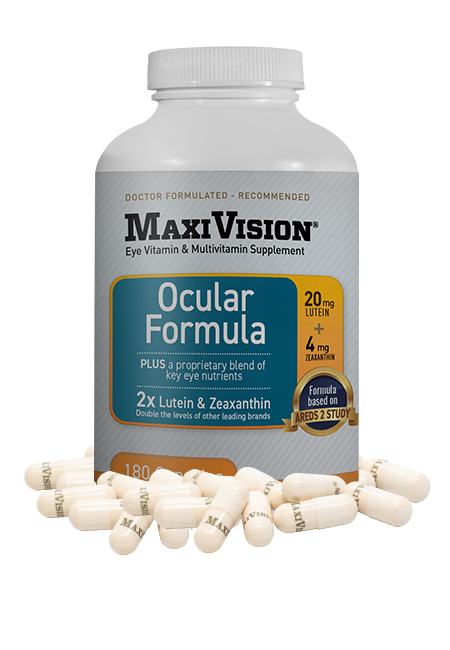



 Shop Best Low-Vision Aids with FREE Doctor Consultation.