
Medically reviewed by Shaun Larsen, OD – Doctor of Optometry. Low vision rehabilitation specialist.
Last clinically reviewed: August 2026 | Next scheduled review: August 2027 | Reading time: 14 minutes
Editorial standard: every clinical claim on this page is sourced to a peer-reviewed journal, a federal agency (CDC, FCC, NIH, VA), or the manufacturer's current published specifications, cited in the numbered references at the end. Prices and plan details were verified in August 2026 and change frequently; confirm at the linked retailer before purchase.
Disclosure: LowVisionAids.org earns a commission if you purchase through the RAZ Mobility links on this page, at no additional cost to you. Our product assessments, hands-on observations, and clinical recommendations are made independently of that relationship.
This page is our detailed product guide to the three accessible cell phones we most often recommend, and sell through our partner RAZ Mobility: the Jitterbug Smart4 (a simplified large-print smartphone), the RAZ Mobility MiniVision2+ (a fully talking keypad phone usable without any vision), and the RAZ Memory Cell Phone (a picture-dialing phone built for memory loss). For a broader editorial comparison that also covers the iPhone, Google Pixel, BlindShell Classic 3, and Synapptic, see our companion guide, Best Phones for the Visually Impaired, on the blog. Here we go deeper on each device: exact specifications, who each phone is clinically right for, and how to fund and set one up.
In our low vision clinic, choosing a phone starts with the functional exam, not the spec sheet. Five findings drive the decision:
Contrast sensitivity, not just acuity. Two patients can both read 20/70 letters on a high-contrast chart yet perform very differently with a phone, because screen use depends heavily on contrast sensitivity. Impaired contrast sensitivity is common in cataract, glaucoma, and age-related macular degeneration (AMD), and in 2024 analyses it contributed more to dementia risk attribution than distance acuity did [4]. Patients with poor contrast sensitivity need bold, high-contrast interfaces (white-on-black themes) far more than they need raw magnification.
Central vs. peripheral field loss. Central scotomas (AMD, Stargardt disease) spare navigation but destroy reading; these patients benefit from large-print interfaces and speech output for long text. Peripheral constriction (advanced glaucoma, retinitis pigmentosa) often preserves small-print reading through a narrow central island but makes finding on-screen targets slow; a physical keypad with fixed, memorizable button locations (MiniVision2+) often beats a touchscreen.
Dexterity and tremor. Essential tremor, Parkinson disease, stroke, and arthritis all degrade touchscreen accuracy. Raised tactile buttons with wide spacing, voice dialing, and single-touch photo dialing (RAZ Memory) reduce the fine-motor demand. This is frequently the deciding factor between a simplified smartphone and a button phone.
Cognitive status. Vision impairment and dementia travel together: roughly 1.8% of prevalent US dementia cases (about 100,000 people) are attributable to vision impairment [3], and when near acuity and contrast sensitivity are included, the population attributable fraction has been estimated as high as 19% [4]. For a patient with both low vision and memory loss, menu-driven phones fail; a single-screen, caregiver-managed device like the RAZ Memory phone is the appropriate class.
Hearing loss and hearing aid compatibility (HAC). Dual sensory loss is the rule, not the exception, in the 80-plus clinic population. Check the phone's HAC rating: M ratings (M1-M4) grade acoustic coupling/interference resistance and T ratings (T1-T4) grade telecoil coupling; higher is better. The Jitterbug Smart4 is rated M4/T4 and the MiniVision2+ M3/T4 [7][9]. Under the FCC's October 2024 order (FCC 24-112), 100% of new handset models must be hearing aid compatible, with Bluetooth coupling and volume-control requirements phasing in [5][6].
"Senior phone" marketing routinely conflates big buttons with accessibility. When we evaluate a device, we test five specific things:
Screen reader completeness. Does speech output cover every screen, including settings, error messages, and third-party content – or only the dialer and messages? A phone that goes silent in its own settings menu is not usable independently by a blind person. The MiniVision2+ passes this test; many 'big button' phones do not.
Font scaling limits. Most mainstream phones cap system font scaling around 200-310% and many apps break beyond that. Purpose-built devices let text scale until words scroll across the screen. Ask: at maximum size, does the interface reflow or does it truncate?
Contrast and polarity themes. True accessibility includes selectable polarity (light-on-dark vs. dark-on-light) because photophobic patients (albinism, cone dystrophy, posterior subcapsular cataract) usually need reversed polarity, while others read dark-on-light better. Look for named high-contrast schemes, not just a brightness slider.
Tactile landmarks. Nib on the 5 key, textured OK button, raised edges between keys – these let a non-visual user anchor finger position. On touchscreens, the equivalent is consistent spatial layout plus haptic/audio confirmation.
Voice control as a dependency risk. Voice commands are a superb accessory and a poor foundation. Speech recognition fails with dysarthria, background noise, weak connectivity, and in accents it was not trained on – and a phone that can ONLY be driven by voice strands the user the moment it mishears. Every phone we recommend can be operated fully by buttons or touch, with voice as a shortcut.
Shop Now
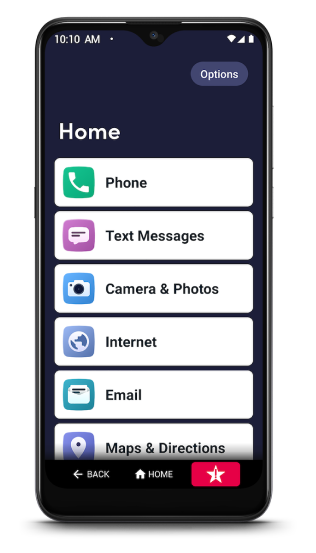
The Jitterbug Smart4, sold by Lively (a Best Buy Health brand), replaced the Smart3 in 2024 and is the current model. It is a real Android-based smartphone stripped down to a large-print, single-column list menu, aimed at users who want texting, video calls, and photos without the complexity of a standard smartphone [7][8].
The Smart4 keeps the line's signature features – voice typing, video chat, and a dedicated Urgent Response button that connects to Lively's 24/7 emergency agents – and adds a larger 6.7-inch anti-glare screen with simplified navigation. With the optional health and safety packages, users can also reach a nurse or doctor around the clock and book discounted rides (details below) [7].
Display: 6.7-inch anti-glare touchscreen (vs. 6.2 inches on the old Smart3), large-print list menu [7][8]
Platform: simplified Android; voice typing; front and 13 MP rear cameras for video chat and photos; 32 GB storage [8]
Hearing aid compatibility: M4/T4 – the highest rating on both acoustic and telecoil coupling [6][7]
Emergency hardware: dedicated Urgent Response button; 4G LTE; works only on Lively service (locked to Lively – it cannot be moved to another carrier) [7][8]
Price: $119.99-$149.99 depending on promotions, plus a required Lively phone plan from $19.99/month (unlimited talk and text; data tiers extra) and a one-time activation fee (about $35). Health and safety packages that add Urgent Response, Nurse On-Call, and related services are an additional monthly subscription – roughly $20-$30/month more depending on tier [7][8].
A big screen: the Jitterbug Smart4 offers a 6.7-inch anti-glare screen that makes reading, texting, and video conferencing more comfortable [7].
Menu is straightforward. The Jitterbug Smart4 is simple to use, featuring a list-based menu and clear icons. You may use it to check your email, send SMS, browse the internet, and more.
Typing using your voice. It's never been easier to send a text message. Your message will appear on the screen after you talk into the phone. For low vision users, dictation removes the hardest touchscreen task – typing on a small keyboard – but proofread before sending: recognition errors rise with background noise and soft or slurred speech.
Live chats. The Jitterbug Smart4 is ideal for video chatting with family and friends, thanks to its built-in front-facing camera and pre-installed apps.
A Loud Speaker. On the Jitterbug Smart4, conversations are loud and clear. You may use the speakerphone to communicate hands-free, listen to music, watch videos, and much more. Combined with the M4/T4 hearing aid rating, this makes the Smart4 our default pick for patients with combined vision and hearing loss [6][7].
Maps, directions, and the internet. Use the Maps and Directions function to get route options and driving directions, and easily access the internet from your phone.
Urgent Response agents are available 24 hours a day, 7 days a week to assist you in an emergency. Simply press the Urgent Response button, and a trained, U.S.-based agent (Lively's agents are certified by the International Academies of Emergency Dispatch) will validate your location, assess the problem, and provide you with the assistance you require [7]. Urgent Response is included in Lively's paid health and safety packages, not in the base phone plan.
You can talk to a doctor or nurse 24 hours a day, 7 days a week from the comfort of your own home. Doctors and registered nurses can provide answers to your medical problems and, where clinically appropriate and permitted by state telehealth rules, prescribe certain common medications [7]. This is a convenience service for minor issues – it does not replace your own physicians, and it is not an emergency service.
Keep family and friends informed about your health and safety. If you call Urgent Response, the Lively Link app helps you stay self-reliant and informs loved ones by sending an alert to their smartphone. The app is free for caregivers on iOS and Android and can also show device status and alert history (verified current as of August 2026) [7].
Helpful and friendly Personal Operators are available 24 hours a day, 7 days a week. Personal Operators can look up phone numbers, make phone calls for you, organize a ride, and provide driving instructions, among other services. For a low vision user, this is effectively a human fallback for every task the screen makes difficult – worth weighing against a cheaper plan without it.
Lively Rides is a car service that is both easier and less expensive than taking a cab. Lively has partnered with Lyft to give you peace of mind while traveling. When you dial "0" on your Jitterbug phone, a Personal Operator will arrange transportation for you at any time of day or night. Rides are billed to your Lively account, so no rideshare app, smartphone gestures, or credit card entry is needed – a genuine independence feature for non-drivers with vision loss. Availability depends on your service package and on Lyft coverage in your area [7].
As of August 2026, the Jitterbug Smart4 lists at $149.99 and is frequently promoted at $119.99 [7][8]. Budget for the true monthly cost, not the sticker: phone plan from $19.99/month, plus a health and safety package (roughly $20-$30/month) if you want Urgent Response, Nurse On-Call, or Lively Rides, plus a one-time activation fee. A realistic all-in figure for a safety-focused setup is $40-$55/month. The MiniVision2+ ($369) and RAZ Memory phone ($369) cost more up front but run on inexpensive BYO-phone plans – the RAZ Memory phone's bundled Affinity Cellular offer is $20/month after three free months [9][10].
Not by itself – and the accessory this page used to recommend, the Lively Wearable2, has been discontinued. Lively's current fall-detection option is the Lively Mobile2, a separate pendant-style mobile medical alert; fall detection is an add-on (about $9.99/month on top of the service package) that automatically connects you to an Urgent Response agent when a fall is detected, even if you cannot press the button [7].
Fall protection matters more in this population than most buyers realize: in CDC's analysis of 2014 BRFSS data, 46.7% of adults 65 and older with severe vision impairment reported falling in the past year, versus about 28% of their peers without vision impairment [1][2]. That said, be realistic about the technology: automatic fall detection performs well in laboratory testing, but real-world validation is limited – one of the few real-world studies of a commercial wearable detected 8 of 10 true falls while also generating false alarms, and systematic reviews consistently note that lab accuracy figures overstate field performance [12][13]. Our advice: treat automatic detection as a backup to, never a replacement for, a wearable button the user can press – and a phone in the pocket is not fall protection at all if it is on the kitchen counter when the fall happens.
Shop Low Vision Phones Now
The MiniVision2 – now sold as the updated MiniVision2+ ($369) [9] – is a simple cell phone with large physical buttons that is fully accessible to people who are blind.
Everything on the screen and entered is read aloud by the phone. Voice commands can also be used to control it to a significant extent. Although the MiniVision2+ is a simple cell phone, it contains a number of smartphone-like capabilities. The MiniVision2+ contains an alarm, camera, FM radio, light detector, color identifier, money identifier, calculator, recorder, voice notes, flashlight, weather, and a "where am I?" feature in addition to making calls and sending text messages. It also carries a dedicated SOS button that can call and text designated contacts in sequence [9].
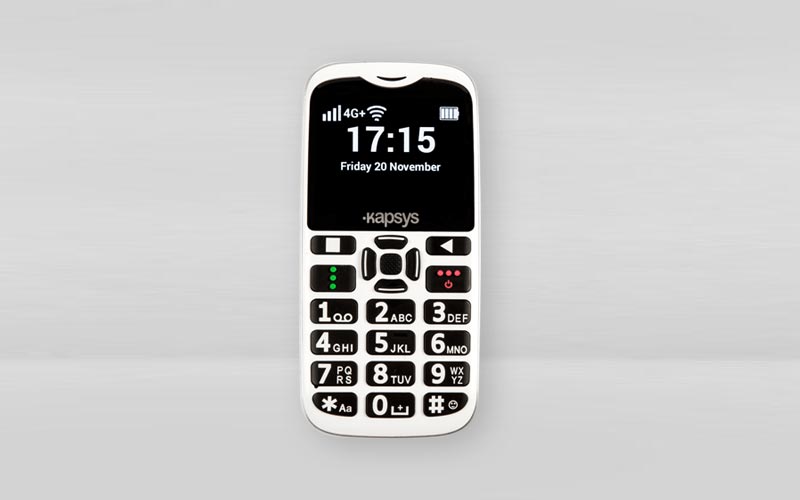
The MiniVision2+ is a compact bar-style feature phone (not a smartphone) that is slightly smaller than an average handset. It measures 4.9 inches in height, 2.4 inches in width, and 0.5 inches in thickness, and weighs just 103 grams – light enough for a shirt pocket or a wrist-lanyard carry [9].
In our hands-on testing of the MiniVision line: It's composed of durable plastic and features rounded edges for a more comfortable grip. The keypad, which has huge black buttons with large white lettering, takes up the lowest sixty percent of the phone. The buttons are evenly placed, making it simple to select the correct option. The navigation buttons, in particular, are very haptic. The surface of the OK button is covered in countless tiny bumps, giving it a unique textured feel. The OK button is surrounded by elevated navigation buttons. Each of the Call and Power buttons has three big bumps on its surface. In short, the keypad on the MiniVision line is the most tactile we've ever used.
A USB-C charging port (upgraded from the old model's micro-USB), a 3.5 mm audio connector for headphones, and two small holes on the phone's bottom edge power the phone when it sits in the charging station. The power and volume controls are built into the keypad rather than on the phone's edge, as is common on smartphones. Battery life is a genuine advantage over any smartphone: the 1600 mAh cell is rated for roughly 200 hours of standby and 7 hours of talk time, so a missed nightly charge does not mean a dead phone by morning [9].
Voice guide turns the MiniVision2+ into a "talking phone," making it fully accessible to blind people. Everything on the screen and everything pressed is spoken by the voice guide. The phone, for example, will read the user's text messages. It will also voice the letters as they are entered when the user is typing the reply. It will say "h removed" if the user deletes a letter, such as the letter "h." The MiniVision2+ gives users all the information they need to operate all of the device's features fully and independently. This is the 'screen reader completeness' standard we described above – speech output covers settings, status, and errors, not just dialing – and it is what separates a genuinely nonvisual-accessible phone from a big-button phone [9].
The voice guide not only gives the visually impaired user access to all features, but it also gives him or her numerous forms of information. It can, for example, speak phone status information like the time, date, and battery power level, as well as alert the user when the phone is charging.
English is the default language. The MiniVision2+ voice guide supports a long list of additional languages, including Spanish, French, Russian, Arabic, and Hebrew [9]. Premium voices are available for free download, allowing users to choose the voice that most appeals to them. The audio guide's speaking pace can be set to regular, fast, faster, or extremely fast.
Many of the MiniVision2+'s fundamental features may be operated with your voice. Most significantly, calls are made by pressing and holding the OK button and saying "call" followed by the name of the person to be called. Similarly, the user can send a text message by holding down the OK button and saying "send message to" followed by the recipient's name. Voice can be used to compose messages. The speech-to-text accuracy is quite good in our experience.
Other parts of the phone can also be controlled using the user's voice. To create a voice memo or add a new contact, for example. Voice can also be used to populate almost any text field.
Voice control is generally effective, and users who like to use their voice have plenty of opportunities to do so. Consistent with our checklist above, every voice function has a button-driven equivalent, so the phone remains fully usable when dictation mishears or there is no connection.
There are four ways to make a call: To begin, the user can utilize the keyboard to dial phone numbers. As the user types the numbers, the numbers are stated aloud. Second, users can make calls directly from their contacts list. Calls can also be made from Call History. Finally, voice commands can be used to make calls. As previously stated, the user presses and holds the OK button while saying something like "Call John."
With the help of the voice guidance, you may type and send text messages. It is an easy procedure to follow. Voice commands and voice dictation can also be used to compose and send text messages. Voice commands are by far the most convenient method of sending text messages. When new text messages are received, the MiniVision2+ will tell the user audibly and display the quantity of new unread messages. Text messages will be read aloud when they arrive.
Even though the MiniVision2+ is a basic cell phone with buttons, it is capable of much more than just making phone calls and sending text messages. An alarm, camera, photo gallery, FM radio, light detector, color identifier, banknote recognizer, calculator, recorder, notes, flashlight, weather, "where am I?" and an emergency feature are all included on the phone. All of these are usable by someone who is blind and work effectively.
In our hands-on testing, we used $1, $10, and $20 bills to test the banknote recognizer feature. The phone correctly and reliably detected the bills. Similarly, the "Where Am I?" feature always gave us the proper address. These and other qualities should be extremely beneficial to blind people.
The font size can be changed to tiny, medium, large, or extremely large. The letters are bigger than any font size on a smart phone when set to very large. In reality, when the font size is adjusted to very large, some words will not fit on the screen and will scroll over the screen. This scrolling large-print mode is exactly the 'no scaling ceiling' behavior we look for – though users with useful central vision should note the display itself is small (2.3-inch QVGA), because this phone is designed speech-first [9].
The color schemes can also be changed by the users. White on black (the default), black on white, blue on yellow, yellow on blue, yellow on black, and black on yellow are among the color schemes available. The selectable polarity matters clinically: photophobic patients generally do best with white-on-black, while others read black-on-white more fluently.
Two additions the original page omitted. Carriers: the MiniVision2+ is an unlocked 4G VoLTE GSM phone – it works on AT&T, T-Mobile, and GSM resellers such as Mint Mobile, Cricket, Straight Talk, and Affinity Cellular, but it does not work on Verizon [9]. Hearing aids: the phone carries an M3/T4 hearing aid compatibility rating, meaning excellent telecoil coupling and acceptable acoustic performance [6][9].
Cost of the Raz Mobility MiniVision2+ Cell Phone
$369 (verified at razmobility.com, August 2026) [9]
Buy Now
As of August 2026 the RAZ Memory Cell Phone sells for $369 and ships the next business day with FedEx 2-day shipping [10].
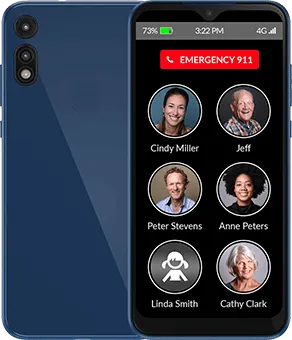
For seniors who prefer an easier experience or those with memory loss, dementia, Alzheimer's disease, or low vision, the RAZ Memory Cell Phone is a straightforward, purpose-built mobile phone. Seniors can maintain contact with friends and family via a phone that has no menus, no apps, no notifications, and nothing to get lost in – one screen, always the same. Clinically, this single-screen design is the point: in dementia with visual impairment, every layer of menu navigation is a failure point, and removing layers – not shrinking them – is what preserves independent calling [3][4].
All wireless service providers, including AT&T, Consumer Cellular, Verizon, T-Mobile, Cricket Wireless, Straight Talk, Red Pocket Mobile, Mint Mobile and TracFone, are compatible with this model of the RAZ Memory Cell Phone because it is unlocked. Additionally, it works with Canadian service providers. Unlike the MiniVision2+, the RAZ Memory phone does work on Verizon [10].
The simplicity of the single-touch dial picture phone is prioritized. There is only one screen in it. Three components are included on one single screen:
Up to six contacts' photos and names per page, from a contact list of up to fifty [10]; a button designated for calling 911 or the alternative RAZ Emergency Service (needs subscription) to prevent unnecessary 911 calls; and the time, battery life, signal strength, and remaining power.
The current phone uses a 6.5-inch, 1600 x 720 display, and the caregiver can enable optional extras – incoming video calls from approved contacts, a voice assistant, reminders, and hearing aid pairing – or leave the phone in its simplest one-screen state [10].
Remote management is the feature that actually sells this phone. A caregiver administers everything from the free RAZ Care app or web portal: adding and editing the photo contacts, restricting incoming calls to an approved list (an effective firewall against the phone scams that disproportionately target cognitively impaired seniors), setting quiet hours, sending reminders, checking battery and signal status, and tracking the phone's GPS location in real time [10]. The person with dementia never has to configure anything, and wandering episodes – a leading emergency in this population – become findable events.
The RAZ Emergency Service is an optional subscription ($13/month plus a one-time $20 activation fee, or $130/year with no activation fee) that reroutes the phone's emergency button away from public 911 to a private dispatch agent who already knows the caller has memory loss [11]. The agent triages, contacts 911 only when warranted, and simultaneously texts designated caregivers, who can cancel a false alarm before responders roll. RAZ reports the service prevents about 95% of unnecessary 911 calls (a manufacturer figure) [11]. The tradeoff to understand: a direct 911 call from any modern cell phone delivers device-based location to dispatchers through Android and Apple emergency location services [14], while the RAZ service adds a human filter in front of that – invaluable for a patient who dials 911 nightly out of confusion, unnecessary for one who does not. Choose deliberately.
Available with a Wireless Charging Set. For a user with memory loss, the wireless dock is not a luxury: it converts 'plug in the cable every night' into 'set the phone down in its spot,' which survives far longer into cognitive decline.
With your purchase, get 3 months of wireless service absolutely FREE with Affinity Cellular! Verizon, the most dependable network in America, powers Affinity Cellular. Only $20 a month after that (offer verified August 2026) [10].
Buy Now
None of the three phones above is the right answer for a technically comfortable user with progressive vision loss. Every current iPhone ships with VoiceOver (a complete gesture-driven screen reader), full-screen Zoom, Magnifier with distance detection, and system-wide contrast and bold-text controls; Android phones ship with TalkBack and comparable magnification and display controls [20]. Both platforms pair with refreshable Braille displays over Bluetooth. The learning curve is real, but the ceiling – banking, rideshare, GPS navigation, AI scene description apps – is far higher than any simplified phone. Our full comparison, including the iPhone, Google Pixel, and BlindShell Classic 3, is in the companion blog guide, Best Phones for the Visually Impaired; and our clinic can train patients on either platform.
Medicare does not generally cover cell phones or medical alert subscriptions, but several programs do fund exactly the devices on this page:
State Assistive Technology Act programs. Every U.S. state and territory runs a federally funded AT program offering free device demonstrations, short-term loans (try a MiniVision2+ before buying one), reuse programs, and in some states financing. Find yours through the AT3 Center directory [17].
iCanConnect (National Deaf-Blind Equipment Distribution Program). If you have BOTH significant vision and hearing loss and household income at or below 400% of the federal poverty guidelines (about $62,600 for one person in 2025), this FCC program provides accessible phones, training, and support free of charge [15][16].
VA Blind Rehabilitation Service. Veterans enrolled in VA health care with impairing vision loss – service-connected or not, and well short of legal blindness – can receive evaluation, devices, and training at no cost through VIST coordinators and blind rehabilitation centers [18].
State vocational rehabilitation and commissions for the blind. If vision loss affects your ability to work, VR agencies routinely purchase accessible phones and training as employment supports.
Civic organizations. Local Lions Clubs and community foundations frequently fund individual assistive devices when no program fits; ask our office or your state AT program to point you to active local funders.
Which of these three phones is right for my level of vision? As a rule of thumb from our clinic: usable central vision plus comfort with touchscreens – Jitterbug Smart4; little or no usable vision, or severe photophobia, with intact cognition – MiniVision2+ (complete speech output, tactile keypad); any significant memory loss or dementia, with or without low vision – RAZ Memory phone, because the caregiver, not the user, manages the device. Dexterity problems push toward physical buttons; dual hearing loss pushes toward the Smart4's M4/T4 rating [6][7][9][10].
Can a totally blind person use these phones without sighted help? The MiniVision2+ – yes, fully: every screen, keystroke, and status message is spoken, and setup can be completed nonvisually [9]. The Jitterbug Smart4 is large-print-first, not speech-first, and is best for low vision rather than no vision. The RAZ Memory phone is operable without vision (large photo targets, optional voice assistant) but assumes a sighted caregiver handles configuration through the RAZ Care app [10].
Do these phones work with hearing aids? Yes, with differences. The Smart4 is rated M4/T4 (best available on both microphone and telecoil coupling) and the MiniVision2+ M3/T4; the RAZ Memory phone supports hearing aid pairing [7][9][10]. If you wear aids with telecoils, activate T-coil mode during calls. FCC rules adopted in October 2024 now require all new handset models to be hearing aid compatible, including Bluetooth coupling standards, so expect this to keep improving [5][6].
Will Medicare or insurance pay for one? Traditional Medicare – no. Some Medicare Advantage plans offer small over-the-counter or safety-device allowances that can offset a purchase; the reliable routes are the funding programs above (state AT programs, iCanConnect for combined vision-hearing loss, VA Blind Rehabilitation for veterans, vocational rehabilitation for working-age adults) [15][16][17][18].
Is automatic fall detection reliable enough to depend on? No single device should be your whole plan. Adults 65+ with severe vision impairment fall at nearly twice the rate of their normally sighted peers (46.7% vs. about 28% annually) [1][2], so the risk is real – but real-world studies of commercial fall detectors show missed falls and false alarms that lab accuracy figures do not capture [12][13]. Use fall detection as a backup to a wearable help button, keep the device on your body (not in a bag), and address the falls themselves: lighting, contrast marking, and orientation-and-mobility training are part of low vision rehabilitation.
What happens when one of these phones calls 911? Any direct 911 call from a modern cell phone sends device-based location (Android Emergency Location Service or Apple's equivalent) to the dispatch center, which is substantially more accurate than older tower-based methods, particularly indoors [14]. The Jitterbug's Urgent Response button and the RAZ Emergency Service both route first to private trained agents who verify location and situation before involving 911 [7][11] – a feature for users prone to confusion or accidental activation, and a consideration (one extra step) for everyone else.
The best way to learn more about low vision aids and pick up the right ones is to visit a low vision professional. It's easy to find one in your area. A low vision evaluation measures the things this page can only describe - acuity, contrast sensitivity, field, and dexterity - and matches them to a device you can try in hand before you buy.
This article is for educational purposes and does not replace an examination by, or the individualized advice of, an eye care professional. Product prices, plans, and features were verified in August 2026 and are subject to change by the manufacturers. If you experience sudden vision change, flashes, a curtain over your vision, or eye pain, seek ophthalmic care immediately.
1. Crews JE, Chou CF, Stevens JA, Saaddine JB. Falls Among Persons Aged >=65 Years With and Without Severe Vision Impairment – United States, 2014. MMWR Morb Mortal Wkly Rep. 2016;65(17):433-437. doi:10.15585/mmwr.mm6517a2
2. Centers for Disease Control and Prevention. About Vision Impairment and Falls Among Older Adults. CDC Vision and Eye Health. https://www.cdc.gov/vision-health/prevention/older-adult-falls.html
3. Ehrlich JR, Goldstein J, Swenor BK, Whitson H, Langa KM, Veliz P. Addition of Vision Impairment to a Life-Course Model of Potentially Modifiable Dementia Risk Factors in the US. JAMA Neurol. 2022;79(6):623-626. doi:10.1001/jamaneurol.2022.0723
4. Smith JR, et al. Vision Impairment and the Population Attributable Fraction of Dementia in Older Adults. JAMA Ophthalmol. 2024. PMID: 39235822. https://jamanetwork.com/journals/jamaophthalmology/fullarticle/2823286
5. Federal Communications Commission. Achieving 100% Wireless Handset Model Hearing Aid Compatibility. Report and Order, FCC 24-112, adopted October 17, 2024. Federal Register, November 13, 2024. https://www.federalregister.gov/documents/2024/11/13/2024-25088/achieving-100-wireless-handset-model-hearing-aid-compatibility
6. Federal Communications Commission. Hearing Aid Compatibility for Wireless Telephones (consumer guide). https://www.fcc.gov/hearing-aid-compatibility-wireless-telephones
7. Lively (Best Buy Health). Jitterbug Smart4 product and plan pages; Urgent Response, Urgent Care/Nurse On-Call, Lively Link, and Lively Rides service descriptions. https://www.lively.com (accessed August 2026)
8. Best Buy. Lively Jitterbug Smart4 Smartphone for Seniors (product listing and specifications). https://www.bestbuy.com/product/lively-jitterbug-smart4-smartphone-for-seniors-black/J3ZHQCQ6LT/sku/6557140 (accessed August 2026)
9. RAZ Mobility. MiniVision2+ Cell Phone (product page and specifications: $369; 2.3-in QVGA display; USB-C; 1600 mAh; 103 g; HAC M3/T4; unlocked 4G VoLTE GSM). https://www.razmobility.com/product/minivision2-cell-phone/ (accessed August 2026)
10. RAZ Mobility. RAZ Memory Cell Phone (product page and specifications: $369; 6.5-in display; up to 50 contacts; RAZ Care app remote management and GPS tracking; carrier compatibility; Affinity Cellular offer). https://www.razmobility.com/product/raz-memory-cell-phone-verizon/ (accessed August 2026)
11. RAZ Mobility. RAZ Mobility Emergency Service – Monthly and Annual Plans ($13/month plus $20 activation; $130/year). https://www.razmobility.com/product/raz-mobility-emergency-service-monthly/ (accessed August 2026)
12. Chaudhuri S, Thompson H, Demiris G. Fall detection devices and their use with older adults: a systematic review. J Geriatr Phys Ther. 2014;37(4):178-196. doi:10.1519/JPT.0b013e3182abe779
13. Real-World Accuracy and Use of a Wearable Fall Detection Device by Older Adults. J Am Geriatr Soc. 2015;63(11). PMID: 26603067. https://pubmed.ncbi.nlm.nih.gov/26603067/
14. Federal Communications Commission. Wireless E911 Location Accuracy Requirements (order addressing device-based location, including Android Emergency Location Service and Apple hybridized emergency location delivered to 911 centers). Federal Register, May 7, 2025. https://www.federalregister.gov/documents/2025/05/07/2025-06865/wireless-e911-location-accuracy-requirements
15. Federal Communications Commission. National Deaf-Blind Equipment Distribution Program (iCanConnect) consumer guide. https://www.fcc.gov/consumers/guides/national-deaf-blind-equipment-distribution-program
16. iCanConnect. How to Apply – eligibility (combined vision and hearing loss; income at or below 400% of federal poverty guidelines). https://www.icanconnect.org/how-to-apply/
17. AT3 Center. State Assistive Technology Act Programs directory (device demonstration, loan, and reuse programs in every state and territory). https://at3center.net/state-at-programs/
18. U.S. Department of Veterans Affairs. Blind Rehabilitation Services. https://www.va.gov/health-care/about-va-health-benefits/vision-care/blind-low-vision-rehab-services/
19. Federal Trade Commission. Guides Concerning the Use of Endorsements and Testimonials in Advertising, 16 CFR Part 255 (updated 2023); FTC.gov, Disclosures 101 for Social Media Influencers. https://www.ftc.gov/business-guidance/resources/ftcs-endorsement-guides-what-people-are-asking
20. Apple. Vision Accessibility – iPhone (VoiceOver, Zoom, Magnifier). https://www.apple.com/accessibility/vision/ ; Google. Android Accessibility Help – TalkBack screen reader. https://support.google.com/accessibility/android/answer/6283677

 Shop Best Low-Vision Aids with FREE Doctor Consultation.Yes! Let's Go

Find out for yourself if you are a candidate for MaculaRevive
Start Now