angle

  • Regain your independence and continue driving
  • Notice the smiles on your loved ones’ faces
  • Rejoice in reading and discovering new things
  • Use customized telescope and microscope glasses.
  • Or fill out the form below and connect with a Low Vision Doctor in your area.

    The Benefits

    Get all the information regarding low vision condition, low vision aids, support information for a family member suffering with Macular Degeneration and other Low vision diseases. Empowered with information you can then get access to a Low Vision Specialist near you.
    Continue to drive

    Our bioptic telescope glasses will allow you to safely see street signs and pass your driver’s test.

    Keep your independence

    Being visually impaired doesn’t mean you cannot do your daily activities. A Low Vision Aid can help you keep an independent life style.

    Read a newspaper and see the detail on TV

    Microscope glasses, handheld magnifiers and other electronic low vision aids make reading possible again.

    Access a specialist close to you

    Our network of low vision specialists are available inn almost every state. And in most cases can travel to a city close to you.

    Get your low vision issues addressed quickly

    Get an immediate free phone consultation from one of our low vision specialist.

    Try the devices before you buy saving time and money

    All devices are available to try before you buy.

    Success Stories

    Low Vision Help in 3 Simple Steps.

    1. Request a free phone consultation with one of our LV specialists near you by filling out the form.

    2. Discuss your visual issues with our professional to see whether you are a candidate for any of our services or products.

    3. Make an appointment with the doctor or look into alternative possibilities suggested by our professional.

    Want to know more about Low Vision?

    Low vision is a condition in which the visual acuity or visual field is decreased to the point where glasses, contacts, or medical treatments cannot correct it to the level for which people can still do normal daily activities.

    lowvision

    Low Vision Aids

    There are many different types of low vision aids, all of which are to help the visually impaired see and function more efficiently in their daily environment. Low vision aids for the elderly such as bioptic telescope glasses help them to continue seeing well enough to drive a car. Low vision devices such as microscope glasses can help the visually impaired to read and write. There are many electronic low vision devices that enlarge print for reading, take pictures of fast food menus or the page of a book and actually read it to the person.

    Wearable Low Vision Aids​

    Wearable visual aids for low vision such as Iris Vision , See Boost, and Vision VR are great low vision tools for people with advanced vision loss. The advantages of these, some offer autofocus, larger fields of view compared to optical low vision devices, audible text reading, virtual reality movie viewing and many other high tech features. The disadvantages are size, they tend to be quite bulky, technically challenging for the elderly and expensive.

    Types of Low vision glasses for Macular Degeneration

    Orcam

    One non optical electronic device is called the Orcam. The Orcam is a vision aid for the blind, it reads text, recognizes faces,identifies barcodes, recognizes money, products and colors. This is a voice activated device that uses artificial intelligence and attaches to any pair of glasses. It quickly can read text from your phone or a book, it stores faces for recall later and can help you maintain your independence by helping you to shop on your own and continue to live an independent life.

    photo 1517948430535 1e2469d314fe 1

    Ruby XL HD

    One of the best selling electronic low vision aids is called the Ruby XL HD by freedom scientific. This Ultra portable device puts crystal clear high definition magnification in the palm of your hands and it goes with you anywhere. It has a 5 inch screen and can magnify up to 14 times while still maintaining clarity. It is good for magnifying newspapers, books, photographs, medications, labels, and more. While many electronic devices aren’t so easy to learn to use, the Ruby XL is very user friendly and is a preferred low vision aid for the elderly. It has easy to use large print buttons and with high contrast colors on it for easy navigation. It allows for color modes to enhance contrast for different ocular conditions. It has a convenient flip out handle for a good grip while reading packaging labels or prescription bottles. It comes in two models one of which is red with colored buttons and the other is grey with high contrast black and white buttons.

    Low Vision Devices

    5893 improvision prismatic half eye black matte spectacles

    Handheld Magnifiers

    Handheld magnifiers come in a variety of sizes, powers and lighted and unlighted versions. They are a form of a microscope with high plus powered lenses. The stronger the power the more magnification but this also reduces the field of view, meaning you see less content. For example 4x low vision aid magnifiers will magnify words two times more than a 2x, but will have to be held two times closer and will have a field of view half the size.. So instead of maybe three words being in view at a time only one and a half are in view. These come either lighted or non lighted and even have wireless charging docks for the lighted versions.

    Bioptics Glasses

    Stand Magnifiers

    Stand Magnifiers also have plus (convex) lenses in them and are mounted in a rigid frame or stand for placing on a table or bench. This allows for hand free functionality. They are used for reading, writing, or any hobbies or near tasks that can be done at a table. These low vision aids are great for paying bills, needle work, model making etc. Most stand magnifiers come illuminated but can also be ordered without illumination. They are great low vision aids for children because they don’t require them to hold them like hand held magnifiers and the reading material doesn’t have to be held super close as with microscope glasses.

    0378 optelec powerscope handheld telescope monocular 400x400 1

    Electronic Magnifiers

    Electronic Magnifiers include things like closed circuit televisions, video magnifiers, large print computer programs like zoom text, screen readers such as Jaws or Virtual Vision. Computer tablets with the feature of being able to enlarge print has also made them an invaluable low vision aid. Electronic devices are great options when considering low vision aids for children. Children are fast learners and adapt well to new low vision devices especially electronics.

    Rehabilitation With Optical Low Vision Aids​

    The success a patient will have with an optical low vision aid is dependent on their visual acuity. Usually these low vision devices are used if the acuity is 20/200 or better. If a lot of magnification is needed a low vision system like a telescope is recommended with the minimum required power to keep the maximum field of view. The field of view will have a great influence on successful adaptation to the telescope. For conditions where the central vision is compromised oftentimes the patient will need to be trained how to use the technique of eccentric viewing. This should be taught before the patient is dispensed the telescope.

    Low vision aids for near vision should be used when the object is having to be held too close or when the patient has to accommodate too much (focus). Up until second grade reducing the distance from the object to the eye is recommended if the acuity is 20/200 or better. From this stage on a stand magnifier, hand magnifier, electronic magnifier, or microscope glasses should be introduced. If the acuity is worse than 20/200 the optical low vision aids should be introduced earlier. When the acuity is 20/800 or worse, braille and a computer with a talking system should be used.

    Low Vision Glasses & Macular Degeneration Glasses

    5893 improvision prismatic half eye black matte spectacles

    Low Vision Sunglasses

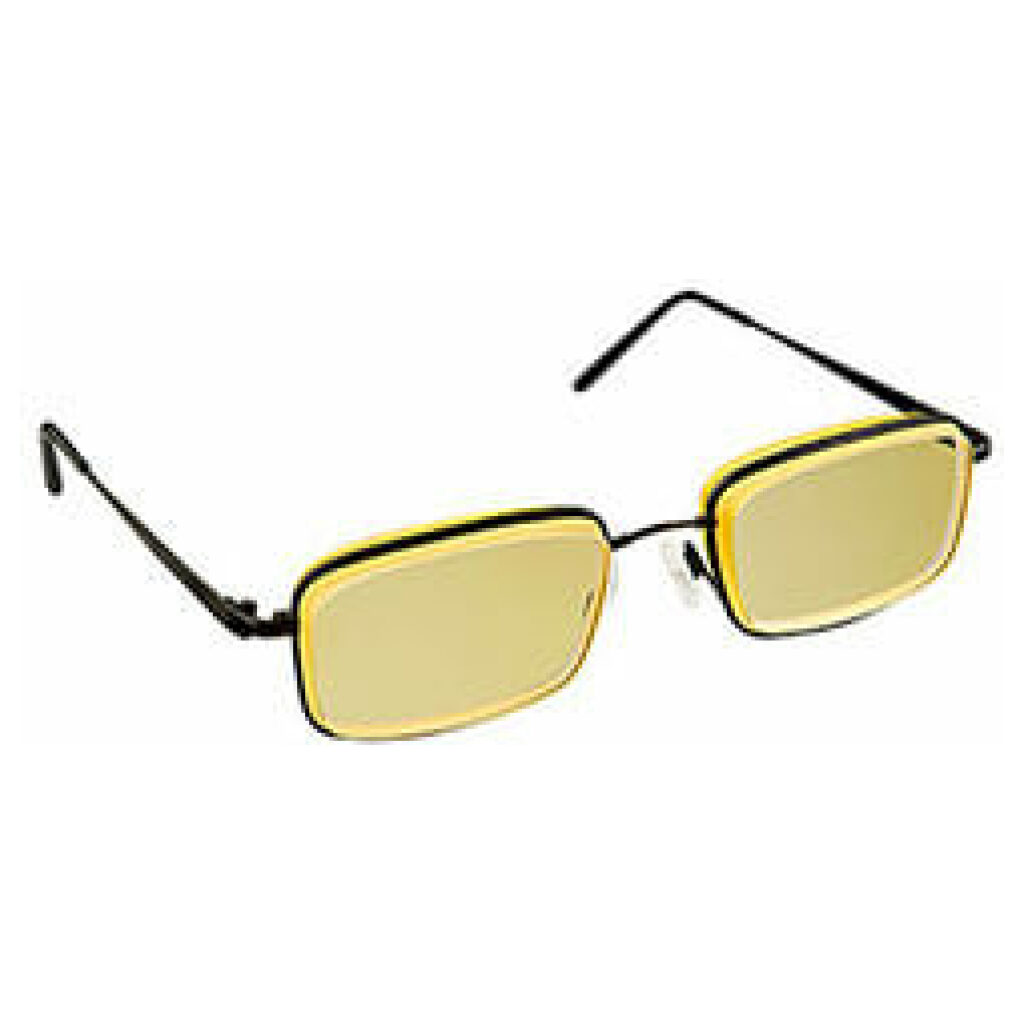
    Low vision sunglasses which have specific filters that reduce glare and enhance contrast. Patients with low vision usually have a vision condition or disease and it’s vital to protect the existing vision and structure from harmful UV rays. Low vision sunglasses come in a variety of forms to compliment other low vision aids being used simultaneously. Cocoons are a common fit over style sunglasses that go over other glasses. Wrap around sunglasses help block side glare and flip up to allow for switching quickly between clear and filtered. An orange filter blocks 100% of the scattered blue light which makes for optimum clarity and can be used indoor and outdoors. It’s used mostly for reading and driving. Yellow provides clarity and contrast and is used mostly for driving in low light situations. Amber reduces glare by filtering 96% of the blue light and is great for contrast. It’s a favorite for outdoor daytime use. Rose lenses are also great for outdoor use and help with contrast and are probably the most comfortable on the visual system which is why it is also prescribed for migraine headaches.

    Bioptics Glasses

    Bioptic Telescopes

    Bioptic telescopes are what are used for driving, the optics of these low vision aids are miniaturized to fit in the top of a pair of glasses. The head is tilted down to view or spot things through them and then returns to the main lens for normal function. Bioptics are great for being mobile because they won’t make the user dizzy. Bioptics can be used in 46 out of 50 states for driving. In those states that they aren’t allowed for driving they are still great for everyday use for spotting and details in the distance without having to take them off to move around.

    0378 optelec powerscope handheld telescope monocular 400x400 1

    Telescope Low Vision

    Telescope low vision aids are handheld spotting scopes. They are usually monocular and can be fixed focused, autofocused, or focusable. These are more cumbersome than the spectacle mounted telescopes but offer more versatility of range and magnification. These can be great for kids just learning how to use the telescopes and getting accustomed to their uses and functions. Once used to them it will be easier to move to a spectacle mounted telescope.

    Tel B tita2s

    Telescopes Glasses

    Full field telescopes glasses offer a large field of view and are mounted straight in front of the eyes for activities such as TV viewing or playing cards. They can also be converged and the focal point set for reading or near work. These can also be a complete low vision system, with the addition of lens caps that fit on the end of the telescope glasses, they can be focused at multiple distances for intermediate or near use. Full field telescopes are usually used in stationary situations. They are difficult to move around with them on because they have a tendency to make the user dizzy.

    Escoop

    Escoop Glasses

    Escoop glasses are a unique low vision tool used for cutting glare, slightly enlarging all things viewed and can shift the visual image to a healthier part of the damaged retina for clearer viewing. These glasses are great for driving at dusk or even night driving. They can help a patient on the border of not being able to pass the vision portion of the drivers test to squeak out that extra line of acuity needed to pass due to the small amount of magnification compared to regular glasses. They can be made clear, or with a yellow or orange tint.

    low vision microscopes

    Low Vision Microscopes

    Low Vision Microscopes have high plus powered or convex lenses in them and provide near magnification for reading or near tasks like sewing. They come as handheld magnifiers, stand magnifiers for low vision glasses.

    Our Mission

    We are committed to providing people with vision loss a high functioning, high quality of life. Helping our patients maintain independence, mobility and safety. We specialize in prescribing low vision aids that are hands free and the most optically advance devices available. Our member doctors do this with compassion, integrity and with the most education and professionalism in the industry.